


 Sign in
  Create Account



A Tunnel Under the Panama Canal
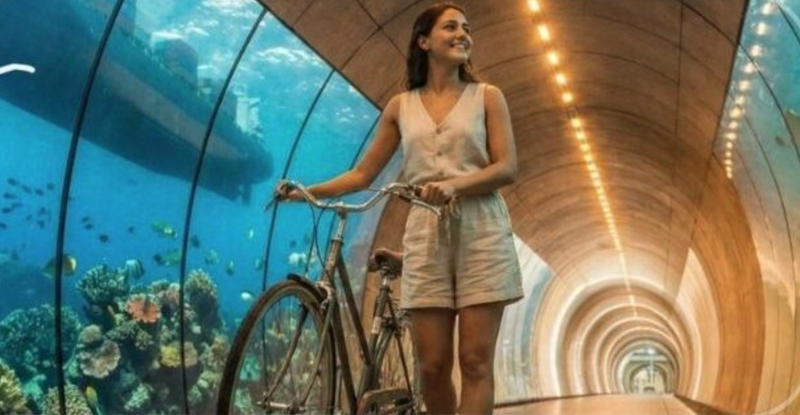
The inauguration of a tunnel, 3.1 Km under the Panama Canal, that will connect Metro Line 3, took place in February. And Panama’s Mayor has an ambitious plan for a pedestrian and bicycle path.
Despite not winning the top prize in a recent tunneling competition concluded in March 2026 a pre-feasibility study for a pedestrian tunnel under the Panama Canal is still underway.
“Regardless of the competition where we were not among the winners, they remain interested in that project and want to delve deeper into the pre-feasibility studies sponsored by The Boring Company, outside of the competition, because they consider it a spectacular project,”
Mizrachi emphasized.
The mayor added that it is encouraging news, keeping Panama on the radar of one of the world’s most important companies.
"Panama continues to shine, and what this shows is that the proposal has its complexities, which makes it innovative and interesting."
The canal serves as both a vital global trade route and a local barrier impacting daily commutes and tourism. The tunnel could potentially transform life on both sides of the canal by providing a traffic-free crossing for pedestrians and cyclists.
Recent Panama Metro Tunnel Inauguration
The inauguration of a tunnel, 3.1 Km under the Panama Canal, took place in February 2026.
A tunnel boring machine (TBM) known as Panama completed the underground path for Metro Line 3, passing beneath the Panama Canal.
During the event, Panamanian President Jose Raul Mulino stated,
“Panamanians know how to achieve great things. We push boundaries and lead the region. Thanks to Panamanian labor, we expanded the Canal and built the region’s first metro. We have Central America’s longest bridge, the continent’s most punctual airport, and two of Latin America’s four largest ports. Now, we add this tunnel.”
Cesar Pinzon, the General Manager of the Panama Metro, also spoke at the ceremony, highlighting,
“This will mean faster, cleaner, and more dignified mobility, reclaiming hours lost in heavy traffic to and from West Panama and turning them into time for family, rest, and personal well-being.”
A Vision for a Connected Panama
“The Canal Underline” envisions a roughly 0.6-mile underground passage allowing people to cross the canal on foot or by bike, free from car traffic. Beyond the tunnel itself, the proposal includes parks and public spaces at both ends, creating community hubs rather than mere transit points.
A City Divided by Water and Traffic
The Panama Canal is both a global trade hub and a physical divider in the metro area. As communities grow, road congestion during peak hours remains a challenge. The pedestrian and bike tunnel could offer a direct and reliable connection for short trips, leisure rides, and tourists.
In a statement on March 24, 2026, Panama City’s mayor noted that the tunneling company remains interested and plans to pursue pre-feasibility studies outside the competition. This phase will assess whether the project is feasible, permitted, and financially viable.
Engineering Challenges Under the Canal
Constructing a tunnel beneath an active canal poses significant challenges, including water pressure, unstable ground, and strict safety regulations. Geotechnical studies are essential to test soil and rock stability. Coordination with the Panama Canal Authority and robust safety systems are also required.
However, Panama has experience with under-canal tunneling, as demonstrated by the Panama Metro’s Line 3 tunnel, which successfully crossed the canal.
Future Prospects and Challenges
If the pedestrian tunnel progresses, the next steps will involve detailed studies rather than immediate construction. Key factors include land control at both ends, connectivity to existing infrastructure, and long-term operational costs.