


 Sign in
  Create Account



Rural Communities Reject Río Indio Reservoir
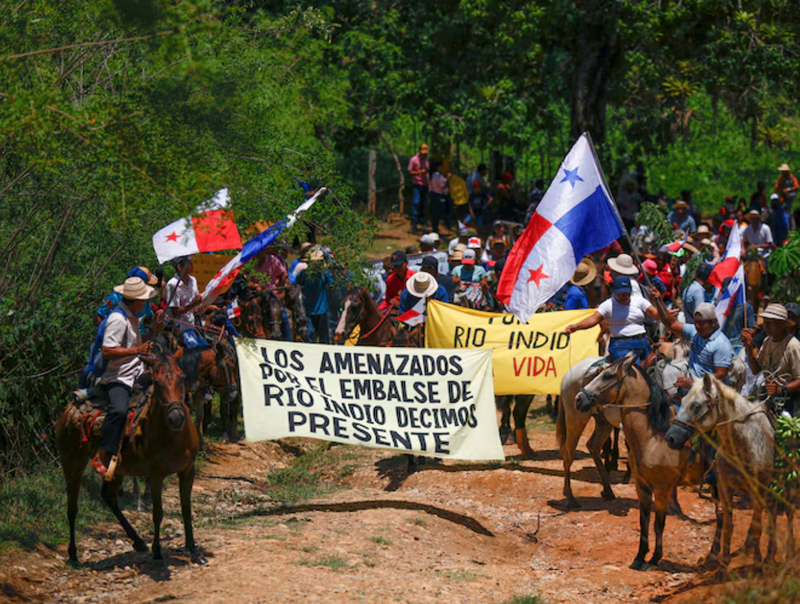
Communities protested on the banks of the river in the community of Limón de Chagres, on the lower coast of Colón, opposing the Río Indio Reservoir on Saturday, April 25th, 2026.
The construction of the reservoir aims to provide water for the population and ensure the operations of the Panama Canal.
The protests come after the Panama Canal Authority announced that it has awarded the contract for the design and construction of two new highways in the vicinity of the Indio River basin.
The company Consorcio Rutas Río Indio (made up of MACASA and RETRANEQ), will take on the project consisting of the construction of 9.5 kilometers in the Las Claras Abajo–Las Marías section, and another 5.6 kilometers between Piedrota and Santa Rosa.
It was reported that the new roads for an amount of $17.5 million were tendered, with the cooperation agreement signed with the Ministry of Public Works.
When consulted, the Panama Canal Authority indicated that “the Río Indio project is fundamental to guaranteeing Panama’s water security ” and assured that its development is being carried out through “an open, participatory and transparent process.”
About the Río Indio Reservoir
The lake will occupy 4,600 hectares, representing 8% of the Indio River basin, which has an area of 58,000 hectares.
The project is progressing and an impact study that will begin in May and will be presented at the end of 2026.
Reports state that there are 500 families that will need to relocate. The Río Indio project moves on to the environmental impact study phase in May 2026.
Karina Vergara , the project’s socio-environmental manager, explained to La Prensa that monitoring is currently underway in the upper, middle, and lower basins, focusing on water and air quality, as well as the behavior of existing species in the area.
One of the main changes that the project will generate is the transformation of the river into a reservoir, which implies modifications to the aquatic ecosystem.
“With this dam, the river will create a new reservoir… we will now have a lake-like environment and the characteristics of the water will change.”
Given this scenario, the Canal Authority is proposing measures to mitigate the impacts, both during construction and operation.
“ We must take steps to ensure that species can be conserved upstream and also maintain sufficient flow downstream.”
Some species require specific flow conditions to survive.
The environmental assessment identifies a high level of biodiversity in the area. There are otters, felines, and a great variety of birds.
This diagnosis has led to considering strategies such as the restoration of biological corridors that allow the movement of species between forested areas.
The baseline study will be evaluated by the Ministry of the Environment. Before its formal presentation, a public participation phase will be held to inform communities about the project and its environmental impacts.
The Canal anticipates that the environmental assessment will be carried out in parallel with other phases of the project, so that the study will serve as a basis for the design and future construction of the reservoir.