


 Sign in
  Create Account



Panama and Costa Rica Sign Memorandum to Develop Central American Railway Logistics Corridor
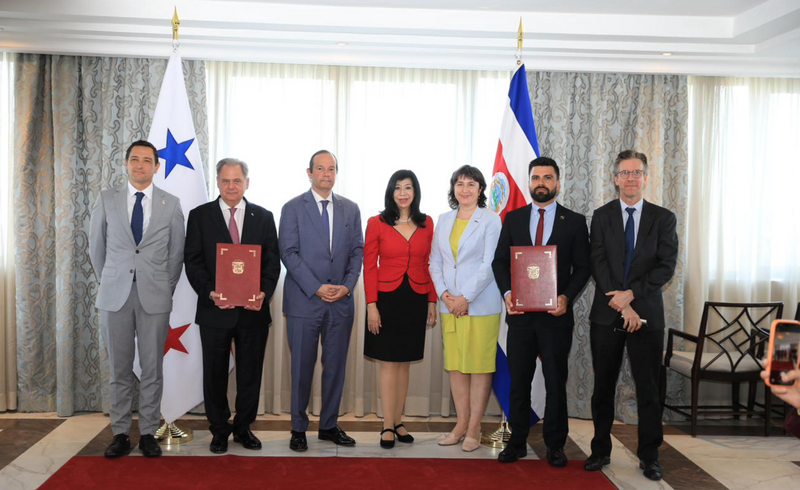
Panama and Costa Rica have signed a memorandum to create a Railway Logistics Corridor from Panama to Costa Rica.
The National Railway Secretariat of Panama (SNDF) and the Costa Rican Railway Institute (INCOFER) signed a document that lays the foundation for a technical and institutional collaboration framework, sharing of specialized knowledge, the alignment of operational standards, the coordination of engineering studies, and joint progress towards regional logistics integration.
The ceremony, overseen by Foreign Minister Javier Martínez Acha, marked the formalization of this bilateral initiative, endorsed by Henry Faarup of the SNDF and Álvaro Bermúdez of INCOFER.
“We are charting a new future, drawing a line on our regional map, dedicated to the progress and integration of a shared future. This project redefines our economic landscape, reducing logistics costs and boosting the competitiveness of the Panama Canal,” stated the Foreign Minister.
He expressed optimism about the shared vision with Costa Rica, viewing it as a regional integration endeavor.
Henry Faarup discussed the project, which began its master plan in January 2025. By January 2026, the Cabinet approved AECOM USA, Inc. for technical advice and feasibility studies. A preliminary route of approximately 475 kilometers from Panama City to Paso Canoas is planned, with fourteen stations and an initial construction phase from Panama Pacific to Divisa.
“For Panama, this memorandum represents the first formal step in establishing the Central American Railway Logistics Corridor. We are not just constructing a train but building the infrastructure for the next generation of the Panamanian economy,” Faarup emphasized.
With this memorandum, Costa Rica becomes Panama’s first partner in this regional vision, advancing its own railway corridor with potential expansion towards Nicaragua. This positions the document as a foundational agreement in a series of future integrations across Central America.
Bermúdez highlighted the importance of the agreement for both nations, enabling them to undertake joint initiatives with significant economic and social impact, enhancing logistics, tourism, and economic activities.
“Let’s continue this collaboration. There is a wealth of technology available today that we can implement, providing opportunities for our countries to innovate and develop uniquely,” he emphasized.
The SNDF announced the commencement of socioeconomic surveys, environmental impact assessments, and conceptual designs for the railway bridge over the Panama Canal. The project aligns with IFC performance standards, World Bank evaluation frameworks, and European Investment Bank criteria as an institutional commitment.
Diplomatic representatives, including those from the United Kingdom, the European Union, CAF, and BCIE, attended the event, reflecting ongoing discussions with the Secretariat.
The project’s strategic identity positions it as a platform for territorial economic development, integrating fiber optics, electricity transmission, water, dry ports, free zones, and port connectivity.
Each of the fourteen stations is designed to serve as a catalyst for local development, enhancing employment, commerce, services, tourism, and regional economies.