


 Sign in
  Create Account



Update on Golden Frogs in Panama and How you can Support Them!
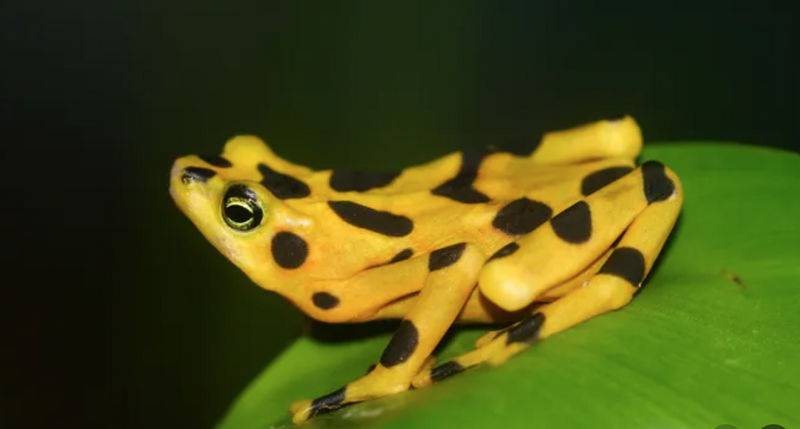
Critical equipment for Panama’s Endangered Golden Frog’s survival in captivity was stolen from Hotel Campestre in El Valle de Anton. *** Please read, share & donate if you can. ***
Recently, critical equipment for Panama’s Endangered Golden Frog’s survival in captivity was stolen from Hotel Campestre in El Valle de Anton. (DONATE HERE)
The Panamanian golden frog (Atelopus zeteki) has been kept alive by the dedicated efforts of conservationists in Panama. In 2026, a new generation of amphibians is being reintroduced into the tropical habitats of Panama.
Forty years ago, there was a huge population of golden frogs in the streams and rivers of the central province of Coclé. However, today, the survival of Panama’s golden frog, an iconic yet critically endangered species, is still under severe threat.
What Happened to the Golden Frog in Panama?
In the late 1980s, the invasive fungus Batrachochytrium dendrobatidis (Bd) began spreading in Central America, posing a severe threat to the golden frogs.
This fungus, which thrives in water, led to dramatic declines in frog populations by causing the deadly disease chytridiomycosis.
By 2009, the frogs had vanished from their last stronghold in El Valle de Anton.
Biologists kept the frogs in Panama (and sent some to the U.S.) alive, successfully creating an environment close enough to the native habitat that they could reproduce, a pretty amazing feat.
In 2026, the Smithsonian Tropical Research Institute (STRI) said in a statement that it “has begun releasing frogs” into “their natural habitat.” On paper, it’s the ultimate success story.
There is still work to be done
In 2026, Popular Science released an article Panama’s golden frogs beat extinction: The amphibians are returning to the wild 17 years after a deadly fungus nearly wiped them out.
The recent release is hopeful news! That being said, biologists will still be doing the work to keep the species from extinction.
Following the theft of essential equipment from Hotel Campertre, many tadpoles are vulnerable, with several already perished. The incident significantly disrupted the dedicated efforts of biologists Heidi Ross and Edgardo Griffith. The loss of ultraviolet lights and other specialized tools has severely impacted their breeding program aimed at preserving this irreplaceable species.
Headlines are important
What we write and share now safeguards our future.
Public support is crucial.
Sharing information is helpful.
Fact-checking and sharing another perspective is too. But stay kind; no one is going to listen if you insult them.
Teaching people to leave the natural world alone (Do NOT touch wildlife. Whether it’s a frog or a starfish, do not pick it up & leave the places you visit cleaner than you found them). Is best accomplished by sharing a small story that connects you... explain your why.
And sharing good news too!
Golden Frogs in Panama Returned to Their Habitat
According to STRI, in 2025, a hundred golden frogs were transferred from the United States and housed for 12 weeks in facilities that recreate their natural conditions. 30% of these frogs “were completely released after the trial.” The release did not specify the location of the specimens for security reasons.
“The data collected from the deceased frogs will be used to understand the dynamics of the disease and how the animals recover the toxicity in their skin after consuming a wild diet,” STRI notes.
Scientists explain that the fungus embeds itself in the animal’s skin, preventing it from exchanging salts and water with its environment. The infection damages its vital functions, and it eventually dies of cardiac arrest due to asphyxiation.
Fortunately, surviving frogs were "rewilded", and the new data allows conservationists to better understand how the disease works.
Last year, three other frog species were released back into their habitats—the crowned tree frog (Tripion spinosus), Pratt’s rocket frog (Colostethus pratti) and the lemur leaf frog (Agalychnis lemur).
If you happen to encounter a golden frog near a Panamanian stream in the future, make sure to only admire it from a distance.
Not only because that what’s best for their survival but also because the amphibians infamously produce several deadly toxins, including steroidal bufadienolides and guanidinium alkaloids.
Trending Tags